

Finding the Human Frequency
The invisible signals we send

I have worked with some students and colleagues who I immediately ‘click’ with. There are definitely others that have taken that little bit more effort. Is this just purely liking someone, and having a similar outlook? Do young people get on with some teachers better than others because they are…‘nice’?
Not necessarily. I worked with someone who was particularly harsh in their critique of creative work - and very rarely handed out compliments. Whenever I speak to former students they always mention this particular tutor with fond memories. They felt that although the critiques were sometimes tough with this tutor, they also felt the person was honest, and therefore gave off a trustworthy persona than a ‘nice’ tutor who gave the same response to everyone, and wasn’t being fully truthful about work.
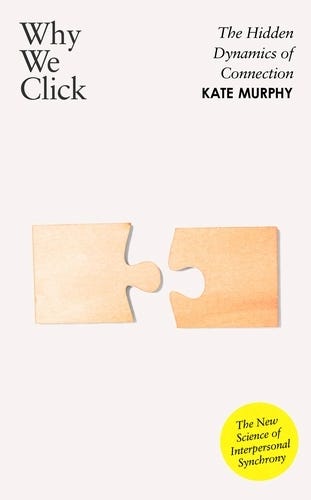
In ‘Why We Click’, Kate Murphy explains that clicking is about the invisible signals we send and receive when we’re physically together - and what happens when those signals start to fade.
Imagine walking into a room full of people, and before anyone says a word, most people already know:
Is this place tense or relaxed?
Is someone upset?
Is it okay to interrupt, or should you wait?
Who feels open, and who wants space?
No one taught you this in a lesson.
You learned it by being around people - watching posture, hearing tone, sensing energy. This is what people mean when they say ‘reading the room.’ Kate Murphy points out that humans are incredibly sensitive to these cues, but only when we’re physically present.
Screens flatten all of this. A message doesn’t carry body language. A video call hides half the signals. Text removes timing, rhythm, and emotional nuance almost completely. That’s why misunderstandings happen so easily online - and why conversations in person often feel richer, even when they’re harder.
“Don’t confuse constant communication with deep connection. Being physically present with others trains skills you’ll need forever”
Murphy talks about connection as something like being in rhythm with another person.
Think about playing music with others. You can practise alone, but real music happens when you adjust to the group - speeding up, slowing down, listening as much as playing. Human interaction works the same way.
In person, those who are particularly good at this:
Match someone’s tone
Pause when they need space
Lean in when they’re excited
Sense when a joke will land - or flop
This rhythm is almost impossible to fully recreate on a screen. Lag, muting, typing delays, and missing body language knock us out of sync. You can communicate online, but the best interactions happen face-to-face.
Kate Murphy isn’t saying technology is bad. She’s saying it’s incomplete. When you work with real tools and real people - building, cooking, fixing, creating - you’re forced to tune into others. You notice frustration. You notice confidence. You notice when someone’s about to give up or have a breakthrough.
Tools anchor us in reality and people anchor us in meaning. A screen lets you stay detached, a shared task pulls you into relationship. It’s where trust, empathy, and understanding grow - not from information, but from shared experience.
As a young person growing up fluent in technology, they are incredibly skilled at communicating, but Murphy’s warning is gentle and important:
Don’t confuse constant communication with deep connection. Being physically present with others trains skills you’ll need forever:
Reading people
Navigating awkwardness
Handling conflict
Feeling part of something bigger than yourself
These aren’t just ‘soft skills.’ They are survival skills for real life. So yes - use screens, and learn online. Message friends, but also step into rooms. Create things together. Collaborate with others.
Notice the energy and feel the rhythm. Let yourself click in the way humans always have. The most powerful connections you’ll ever make won’t come from better technology - they will come from being fully, attentively, human.
Thanks for reading as always - I hope you are enjoying the half-term - if you are taking it. Daffodils, snowdrops and crocuses are starting to appear here - thank goodness! Enjoy the weekend, and see you back here next week 😊
“The unique blend of passion, practical experience, and mentorship makes the HatchEd tutor an exceptional educator. I admire her commitment to empowering young minds to excel in the world. Without a shadow of a doubt, I wholeheartedly recommend HatchEd to anyone seeking not only an exceptional teacher but also a mentor who deeply cares about the success of their students. She’s truly outstanding.”
Rona Marin-Miller, Designer and Parent.